A magnetic latching relay (also known as a bistable relay or magnetically held relay) is a type of relay that switches states via pulse signals and maintains contact positions using permanent magnets. Its key feature is that no continuous power is required to sustain its state, offering advantages such as low energy consumption and high reliability. Below is a detailed breakdown of its working principle:
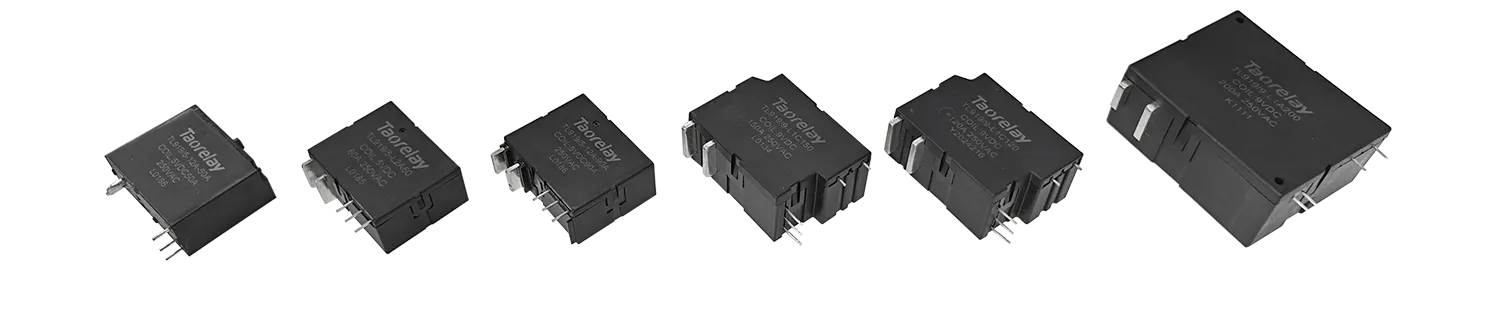
I. Core Components
- Permanent Magnet: Provides a stable magnetic field to hold the contacts in position.
- Coils: Typically includes a forward coil and a reverse coil, generating temporary magnetic fields when pulsed.
- Armature: Driven by magnetic forces to move and actuate the contacts.
- Contact System: Opens or closes the electrical circuit.
II. Working Mechanism
- State Switching (e.g., Closing Contacts):
- Forward Pulse: The forward coil is energized, generating a magnetic field aligned with the permanent magnet. The combined magnetic field strengthens, driving the armature to close the contacts.
- State Retention: After actuation, the permanent magnet’s field alone holds the contacts closed without further power.
- Reverse Switching (Opening Contacts):
- Reverse Pulse: The reverse coil is energized, creating a magnetic field opposing the permanent magnet’s field. This cancels the holding force, allowing the armature to reset and open the contacts.
- State Retention: The permanent magnet’s field maintains the open state.
III. Key Features of Magnetic Latching Relay
- Bistable Design:
- Two stable states (open/closed), both maintained by the permanent magnet without external energy.
- Pulse-Driven Operation:
- Requires only brief current pulses (milliseconds) to switch states, minimizing energy use.
- No Mechanical Locking:
- Relies on magnetic circuits for state retention, reducing mechanical wear and extending lifespan.
IV. Applications
- Smart Meters: Remote circuit control with minimal standby power.
- PV Inverters: Efficient switching in DC circuits.
- Industrial Automation: Low-power, high-frequency switching scenarios.
- Power Systems: Circuit breakers or remote control requiring high reliability.
V. Pros and Cons
- Advantages:
- Energy-efficient: Power only consumed during switching.
- Long lifespan: No continuous current reduces coil heating or degradation.
- Vibration-resistant: Magnetic retention outperforms mechanical locking.
- Disadvantages:
- Higher cost: Requires permanent magnets and dual-coil design.
- Complex control: Requires forward/reverse pulse circuits.
VI. Comparison with Standard Relays
- Standard Relays: Require continuous power to maintain states, leading to higher energy use and coil aging.
- Magnetic Latching Relays: Pulse-driven + magnetic retention, ideal for long-term or remote-controlled systems.
By leveraging these mechanisms, magnetic latching relays excel in energy efficiency and reliability, making them ideal for systems requiring sustained operation or remote management.